Thursday, August 11, 2016

Cold Mountain


This book came to me highly recommended, but I was tempted to give it less than two stars.

Somehow I did find my way to the end of the thing. That was some time ago and I don't remember any of it. All I remember is that it wasn't an easy journey. At times I remember thinking I would gladly trade my struggle to read this dense, tiresome, and incoherent prose for the hapless journey of its caricatured protagonist through the War ravaged South!

I won't attempt to recreate the story line here - there wasn't one. Such as it is, it could be summed up in one sentence, "A man find's his way home." So the "substance" of the novel has to do with an attempt to convey history, and the human condition, in an intriguing, poetical, and insightful manner. That is a noble aspiration. The problem is that the author completely in his effort to accomplish it.

That this book is held up as a noteworthy novel is an insult to the literary tradition of the American South, which has produced such great writers as Faulkner, O'Connor, and Tennessee Williams. It simply has nothing new to say about anything, and doesn't do so in the most pretentious, predictable, (and yet also nebulous and dreary) manner conceivable!

It's fame is not a negative testament to the incapacity of American writers - but to the ineptitude and corruption of current publishing and criticism - the state of which, is for the most part, a scandal and like this novel a disgrace.

Brent Hightower
Copyright 2014 Brent Hightower
21stcenturyperceptions.blogspot.com
*Image public domain

Tuesday, June 28, 2016

A Balanced Look at Justinian and Theodora? (a review of Theodora Empress of Byzantium)


This novel was well researched and clearly written by an author steeped in the deep complexities of the Byzantine Age, but I had a real problem with his apparent intention to "rehabilitate" the reputation of Empress Theodora, regardless of almost any degree of moral ambiguity and contradiction. It seemed as though the author could find no consistent world-view - no clear lens through which to interpret the life of this woman; one of histories trans-formative figures.

In the author's defense he isn't alone in this difficulty. The tremendous moral, political, and cultural complexities of the Byzantine Age often afflict those who attempt to chronicle them with a deep confusion!

Although the dominant perspective of the novel is clearly Catholic/historical and attempts to present Theodora as a defender of the faith, at other points I felt as though the author were presenting her from a modern feminist perspective. At yet other times I felt as if he were defending her from the charge of relentless and single-minded cruelty, of ruthless tyranny, and doing so from the perspective of a purely Machiavellian pragmatism! And these are just the beginning of the unresolved contradictions in the book.

My problem is not that I can't envision a person of that complexity. There is, obviously, virtually no limit to the potential complexities of the human personality. A failure to delve deeply enough into that complexity is, in my opinion, the failing here. The mystery of Theodora, the subject of the book, has defeated him. Her life remains an enigma that simply resists his every attempt to make it conform to some handy modern concept, to put it in some "box" where a modern reader can glance at it, understand it, and turn away content that their essential world-view hasn't been disturbed - because the far deeper truth is that if you look at Theodora's life and you aren't both confounded and deeply disturbed then you simply haven't been paying attention.

Brent Hightower
Copyright 2016 Brent Hightower
21stcenturyperceptions.blogspot.com

Friday, June 24, 2016

Hypatia, Alexandria, and Holy War

I cannot give the author enough credit for writing such an enlightening account of the life of Hypatia based upon such limited historical resources. This was clearly a labor of love and the result of painstaking research.

I found the book to be enlightening in a number of ways - firstly, in the way Ms. Dzielska clearly illuminates a very complex historical era, so that it is approachable for any educated reader - secondly, in the manner she clearly introduces the reader to the neo-Platonic concepts Hypatia taught and represented with her life, and finally, the lucid manner in which she develops her case for the reasons Hypatia was murdered.

Hypatia of Alexandria is, in my opinion, a work of first-rate scholarship and literary artistry: I will not say anything regarding the book's conclusions and thereby possibly diminish the enjoyment of this book for the reader - only that I am not entirely convinced by the somewhat startling final thesis. Yet that reservation in no way diminishes either the solid factual foundation of her argument or the brilliance with which she presents it.

I would highly recommend this volume to anyone interested in late antiquity, in neo-Platonic philosophy, or the development of Christianity in Byzantium.

Saturday, April 9, 2016

The Stranger


A Review of The Stranger by Albert Camus

It has been perhaps three years since I've read The Stranger, but the book left an indelible impression on me. The reason, I think, is that this under appreciated work addresses the most profound question of our times: the question of the narcissistic and anti-social personality disorders and their challenge to civilization. Beyond a doubt this was the question Camus was addressing here, and he was doing so long before these issues were in the forefront of psychological thought.

In his seemingly casual anticipation of the significance of these conditions and his realistic interpretation of their banal nature lies the work's misleadingly prosaic quality; yet under that seemingly tepid surface lies the horror of the human spirit disconnected from love.

This, along with the crystal clear prose that always characterized Camus, resulted in an understated novel that is a triumph of Western Literature.

Whatever our interpretation of the origins of these mental conditions, or our understanding of their meanings - whether it is the result of overpopulation, or of individualism vs. the collective good, or of simple genetics, or of some other factor - there is no doubt that this is the great question of the twentieth and twenty-first centuries. From Hitler to Ghandi, from spirituality to science, from plutocracy to democracy, from frugality to materialism: human nature itself is the catalyist and human nature comes down to the individual.

Within this mystery of the individual, as much as that of society itself, lies the origin of the two world wars and all of the subsequent strife of the hyper-material age. We are trapped in a duality between survival and connection, between selfishness and transcendence, between life and death.

That "The Stranger" can be completely unmoved at his own mother's funeral, that he can exist isolated from any emotional connection and that he can eventually be led to murder without any more effort than a child is led to candy is the profound message of this novel. It is a condemnation of our increasing isolation from one another, from community, and from spirituality. It is a clarion call alerting us that an individualistic, impersonal, hyper-technical society not only produces these people, but perhaps even encourages them, and at times elevates them to positions of great power.

With the second world war in clear hindsight it was this towering quandary that clearly absorbed Camus in this work, and there is no more important question for a current reader to engage.

And so, seen in it's proper light, "the Stranger" is a riveting story of loveless alienation, spiritual meaninglessness, and of the inability of the individual to even understand what they are missing - the kind of existence that resulted in a Nazi Germany or a Soviet Russia, and of it's consequences. We must not allow our distance from this work in space and time to obscure the fact that it is still the central question of today. That was the gift Camus gave to us in The Stranger, and we should receive it with gratitude.

Brent Hightower
Copyright 2012 Brent Hightower
21stcenturyperceptions.blogspot.com

Friday, March 11, 2016

Light In August


A review of Light In August by William Faulkner:

In "Light in August," Faulkner achieves the highest standard of prose I have read in an American novel. There were passages I read over and over again, and I marveled at the sheer visionary concentration of the writing - at the author's ability to focus on a specific scene so clearly, so intently, that he brought me completely into his vision. The below description of nothing more than a wagon rolling down a country road, is a fine example:

"The sharp and brittle crack and clatter of its weathered and ungreased wood and metal is slow and terrific: a series of dry sluggish reports carrying for a half mile across the hot still pinewiney silence of the August afternoon. Though the mules plod in a steady and unflagging hypnosis, the vehicle does not seem to progress. It seems to hang suspended in the middle distance forever and forever, so infinitesimal is its progress, like a shabby bead upon the mild red string of road. So much is this so that in the watching of it the eye loses it as sight and sense drowsily merge and blend, like the road itself, with all the peaceful and monotonous changes between darkness and day, like already measured thread being rewound onto a spool. So that at last, as though out of some trivial and unimportant region beyond even distance, the sound of it seems to come slow and terrific and without meaning, as though it were a ghost travelling a half mile ahead of its own shape. . ."

It takes tremendous focus and commitment to create such evocative prose, and I have to admit that it took me many years to become patient enough, and reflective enough, to fully appreciate Faulkner for his descriptive brilliance. An equally great, or greater achievement of this novel, was in his commitment to portray human existence exactly as he saw it. There was really no social or political "agenda" in Faulkner's work at all, in my opinion, although some have made that claim. Instead, what I see, is a courageous and unflinching determination to portray his world with absolute fidelity, to hold a mirror up to life and human society, so that we might look at that image and draw our own conclusions about where society has succeeded and where it has failed.

This, in my estimation is a heroic and monumentally difficult thing to attempt, and not only does Faulkner attempt it in "Light In August," he achieves it admirably. As in the passage excerpted above, what I see in Faulkner's work is courage: the courage of a writer willing to face himself and to portray both his inner-impressions, and his external reality unflinchingly, with the deepest exertion towards absolute honesty. I can think of no higher praise for any writer, or any novel.

Brent Hightower
Copyright 2013 by Brent Hightower
21stcenturyperceptions.blogspot.com

Tuesday, December 8, 2015

Oh God Where Art Thou?

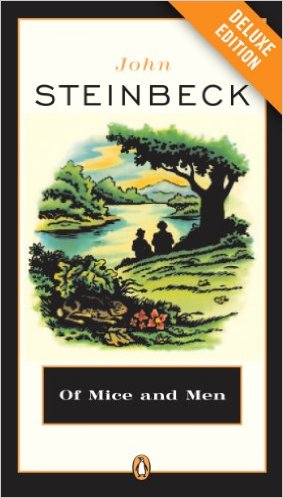
When I think of the collective works of American literature (and by American here I mean the U.S.) only a handful come to mind as indisputably great, that is as works to hold up against the greatest writers that have ever lived, against the likes of Cervantes, Dickens, Victor Hugo, or Dostoyevsky, and one of them is this slim volume by John Steinbeck, Of Mice and Men.

On the surface it seems plain enough, a story about a couple of hard luck cases, one of whom is mentally disabled, who end up getting jobs on a ranch in California. It soon becomes clear that the simpleminded Lenny, who is a great ox of a man possessed of tremendous physical strength, has been relying on the other man, George, for quite awhile to help him cope with life. Lenny likes small animals but with his great strength often accidentally kills them (and here we have the first instance of the profound metaphor that dominates the book, for Lenny's ineptitude in taking care of these small animals is seen in the light of the equal ineptitude of either God or fate to provide for Lenny.)

So to go on without giving away too much of the plot for those unfamiliar with the book I will just say that it is this motif - rage at the sheer lack of pity, at the sheer haphazard, arbitrary, and capricious nature of life played out in manifold and interwoven themes - that is what makes up "Of Mice and Men." Steinbeck handles these themes in the stark, minimalist prose, so admired in the mid-twentieth-century with singular mastery. It is clear that he exerted painstaking effort to make every passage resound with understated yet monumental indignation at the plight of mankind (for the people on this ranch are mere microcosms of mankind, caught up in a universal play) in a set of circumstances they are no more in control of then are the mice that Lenny loves and haphazardly destroys.

The book is an extended cry of outrage at the capricious fate we all endure, and at the apparent absence in all the vast universe of any chord to vibrate with a single note of sympathy. Of all the existential works written in the era of existentialism, to me Of Mice and Men stands alone as a work of art.

Brent Hightower
Copyright 2015 Brent Hightower
21stcenturyperceptions.blogspot.com

Tuesday, May 26, 2015

Justine

Justine was something of a rarity for me, a genuine classic recommended by a friend that I came across fairly late in life (in my late forties)and as such it was a real delight to read. I went on to finish the three remaining volumes of Durrell's 'Alexandria Quartet' in succession and the whole did not disappoint one bit, but of these four great novels I think the first volume, "Justine," is the best.

Durrell is one of those rare writers whose prose is genuinely poetic. It is sensual. I have rarely, if ever, read prose of such grace. One is conscious of the care given to each sentence - and the manner in which he weaves this descriptive sensuality into a cohesive picture is reminiscent of the brush strokes of Monet or a Cezanne. It leaves you not with just a vivid impression of Alexandria, or of the characters that people the book, but with something more. When I finished I truly felt, to a unique degree, an intimate knowledge of the city. It felt as if I had been there.

It's not that other authors haven't produced a vivid impression on me, it's just that they have not produced the same impression. Durrell gives us Alexandria as an epicure gives us a fine Parisian restaurant, or as a lover describes a new romance. One can smell the profusion of flowers in that city, know the way the city felt at sunset. The novel is intimate: but there is something else here, something a little disconcerting: perhaps the hint of genuine decadence? It's reminiscent of Baudelaire, a profoundly beautiful writer, who yet strongly veered towards decadence.

Clearly Durrell was in love with Alexandria, and in this beautifully written series of novels he communicates that love with singular power, while accomplishing something even more remarkable: he ties together the personal with the universal and these things in turn with our strangely personal perception of time, creating a unique perspective. In Justine he successfully interweaves all these elements in a manner original enough to be an artistic triumph of the highest order.

Yes, he was in love with Alexandria, and he was in love with "Justine. . ."

Yet the title character of this novel remains a mystery. We know the city whereas we cannot know Justine - and she remains a mystery throughout the series of novels. Her mystery forms the thread in this quartet of books, and as she is seen from the perspectives of the differing characters who narrate each separate book she changes, she transforms.

This question "who is Justine?" and through that question the question of "who is the narrator?" is the driving force in these books. Our view of her, and all those involved in the story, expands through the perspectives of different observers until finally we are forced to ask the question, "Can we really know any of these people at all?"

It is here that although I retain the highest admiration for Durrell as a descriptive writer and a writer of many other great attributes, I am confronted with the pervasive moral ambiguity of so many mid-twentieth-century writers. Durrell, it seems to me, answers this question in the negative. "No, we cannot ultimately know these people, he seems to say. We cannot ultimately even know ourselves." And here I, your humble reviewer, will go out on a limb and say I believe this embrace of moral ambiguity has contributed greatly to the decline of Western culture since the mid-twentieth century.

Each generation has its dogma, its beliefs that must be held for the individual to be taken seriously, and it was this I believe shallow cynicism in the guise of existentialism that was his generation's dogma absolute. It was a world-view so widely held at the time that my admiration for Durrell's accomplishment here is only slightly dimmed by his acceptance of it, and I believe it is partly this moral ambiguity that created a tinge of decadence in Justine.

Brent Hightower
Copyright 2015 Brent Hightower
21stcenturyperceptions.blogspot.com

Saturday, April 4, 2015

On The Emerging New Class Of Writer


(Please see my article, "A few More Inconvenient Truths," about Alan Turing and the Universal Machine, as a companion piece to this article.)


I'd like to write about an aspect of the complex world of literature in this era, that is in part, contradictory to what I wrote in an essay about poetry. In that earlier piece I wrote about the descending spiral affecting modern poetry, in that because people do not buy poetry,the quality of poetry declines, resulting in even fewer people buying poetry, and so on...

I would just like to say, as an aside, that I'm not particularly uncomfortable with contradiction, if it concerns aspects of a problem as convoluted, and contradictory, as that of modern publishing. Life presents us with contradictions, and when that is the case acknowledging it is necessary to the pursuit of truth.

At any rate, having made the case for the necessity of writing as a profession, I would like to look at the issue of the emerging new class of writer in our society, the blogger, the internet writer, the citizen journalist.

In at least one important way this new class of writer is a boon to the integrity of modern publishing, in that unpaid, unaffiliated, citizen writers, can simply say anything they want to. Whether it is acknowledged or not, established writers who work for newspapers, or publishing houses, or almost any profit driven entity are inevitably influenced in what they say by such affiliation. The academic writer is freed from this pressure to a great degree, but the academic writer must always think of how his or her writing will be received by peers, a thing which is a double edged sword. It enforces a high standard of production, professionalism and rigorous thinking, but also reduces creativity and discourages original thought, and perpetuates conformity and redundancy in expression. So the freedom of expression attained by this new class of unpaid writer, in the era of the internet, is probably unprecedented since the invention of the printing press! A completely unaffiliated writer, unpaid for their work, can now say whatever they want to say, while also reaching an audience! There is no one to prevent them from publishing whatever they want to, as I do here on this blog, and there is a tremendous amount to be said for that!

Yet we are left with this quandary: although this unprecedented freedom of expression is a boon to writing, it is also anathema to writing, in that it allows for an enormous amount of expression, while at the same time allowing for no effective means of separating the wheat from the chaff. The sheer amount that gets published makes any serious attempt at critical evaluation of that content impossible, and so there is no way for anyone to know what part of that output is of real value. Many people might say to this: "Fine, then we have a 'free market' of ideas in which people can pick and choose what interests them."

The problem with such thinking is that we run into the above cited problem with poetry. Not all ideas, not all art, not all critical thinking, not all journalism - or whatever writing is in questio - is created equal. And if nobody is able to make a living in writing, as well as having the freedom of expression to write what they will, then the quality of writing (and thus of culture, and of thought itself) will rapidly devolve to the lowest common denominator.

This problem is quite humorously laid out in the movie Idiocracy, and has been understood since at least the time of Plato. To avert such cultural and intellectual decline, somehow the quality of creativity must be protected and advanced. So here perhaps, more than anywhere else the question must be confronted. . . "If the computer replaces human labor, even in intellectual endeavors, as it is already doing, then as technology advances, will we lose the ability to preserve meaningful culture altogether?

Those most enamored of the "free information" generated by the computer are consumers of that information, not its creators, and that inherent imbalance between these interests could spell the end of higher culture over time, resulting in "Idiocracy."

I don't have the answers to all the questions generated here, but I think, as a society, we need to seriously grapple with those questions, in order to preserve a society worth living in.

Brent Hightower
Copyright 2015 Brent Hightower
21stcenturyperceptions.blogspot.com

Thursday, February 26, 2015

A Masterful Synthesis

The impression many readers have of Walter Scott is that he is a dull writer; and it's true that his prose seems at first unapproachable for those used to twentieth and post-twentieth-century fiction. That is why I would recommend Old Mortality as an introduction to any reader unfamiliar with his work. It is a flat-out barn burning adventure story, really thrilling to read, and as is much of Scott's work also a vivid window into history - the history in this case fascinating for both its foreignness from our times (far greater than one might suppose reading a book about such a relatively recent era in Scotland), and also for its stark, even frightening, similarity to our times.

It is set in the late seventeenth-century, in a nation still in the throes of a decaying feudal system, beset by religious warfare and corresponding conflict between the impulses of modernity and reaction; and this feeling of both closeness and contrast to modern times holds one of the book's fascinations.

The setting is of course also memorable, and finely drawn. What better scene could there be than this brooding landscape of castles and mists - rugged coastlines and crags - carved everywhere by ever-flowing water? Something about that land seems to endow all human action with an epic grandeur, and the undoubtedly epic action of the book is enhanced by that backdrop and finally by another of Scott's great strengths - the brilliance of his characters. Every character in this novel rings true to life, but particularly the mad, indomitable, religious-zealot at the center of the action. He is a man one cannot like (or at least I cannot) but whom I found fascinating and came to have a grudging admiration for, if only in the manner one admires a sheer force of nature!

And finally, Scott had a mastery of the structural architecture of the novel. This intense, complexly interwoven story of a love torn apart by differing visions of life is rendered seamlessly and with vividly clarity, so that in the end one feels they have not only read a ripping adventure story, but also seen a brilliant picture of a very remote world, vivid enough to afford a new perspective on the meaning of our current age.

Brent Hightower
Copyright 2015 Brent Hightower
21stcenturyperceptions.blogspot.com


Saturday, December 6, 2014

Titus Andronicus

"I tell my sorrows to the stones..."

"I tell my sorrows to the stones..." These chilling words from Shakespeare's tale of loyalty betrayed by power reverberate profoundly in our world today, and in my mind this play's subject matter takes it off the shelf and puts it into the forefront of the current Shakespeare canon. I say this despite readily admitting that the language of Titus Andronicus does not equal that of Shakespeare's later plays - that it is the most crudely wrought of all his works - but even this fact does not devalue such a powerful, passionate, and indignant vision of a world utterly deprived of justice.

The only word for this vision would be apocalyptic, and it is interesting to me that Shakespeare initiated his career as a tragedian with such a work, and ended it many years later with an equally apocalyptic work in King Lear, and that in both of these plays the fatal element is human nature. That, it seems to me, is what Shakespeare most wanted to leave us with as a writer, an impression that human nature itself is the critical element in human tragedy - that we essentially create tragedy with our own hands, and without a widely shared vision underpinning a moral order there is no way to construct a reality devoid of horror. So for readers who have the strength to endure its terrible violence and unrelenting pathos there is a message to be taken from this play that is crucial, and that is that there is simply no limit to human cruelty once a shared spiritual and intellectual vision is lost.

That appears to have been Shakespeare's first and last word to posterity, this unflinching look at the horror of life in a world predicated on nothing but the struggle for survival. For this reason alone Titus Andronicus is a great play and should be among the must-read works for anyone seeking to understand the broader meaning of Shakespeare's contribution. It is a recurring question in human existence, one that must be faced again and again by each successive generation, and in Titus Andronicus Shakespeare clearly wanted to convey the devastating result of the failure to reach for a higher spiritual plane.

Brent Hightower
Copyright 2014 Brent Hightower
21stcenturyperceptions.blogspot.com